
Reusable worlds
Once a character or set exists, later shots can reuse it—critical for pilots, episodes, and product series.
3D animation
3D animation is moving imagery created inside a three-dimensional digital space. Artists (or a directed AI-native pipeline) model characters, props, and environments, place virtual cameras, light the scene, and generate frames that read as volume, depth, and physical presence. Unlike 2D, which lives on a drawn plane, 3D lets you orbit a performance, relight a set, and reuse assets across shots. Buyers commission 3D when a world must feel inhabitable—product films, cinematic pilots, branded entertainment—not when they only need simple diagrams.
Definition
The “3D” is not a look. Photoreal CGI, stylized characters, and graphic product films can all be 3D. What they share is a spatial pipeline: assets exist independently of any one frame, so a director can change lens, timing, or lighting without redrawing the entire scene.
Software such as Blender or Maya is how many teams build those assets. A production studio is how those assets become an approved film: story, boards, continuity, sound, review, and delivery.
If you are comparing vendors, start with 3D animation services — what a studio actually delivers versus a software license.
Definition
3D animation is the craft of staging motion in a digital volume—form, camera, and light—then rendering that staging into finished shots.
How it works
Whether the render engine is traditional CGI or an AI-native pipeline, the production spine stays the same.
Lock the audience, runtime, and visual language. Decide what must stay consistent: faces, materials, camera grammar, brand color.
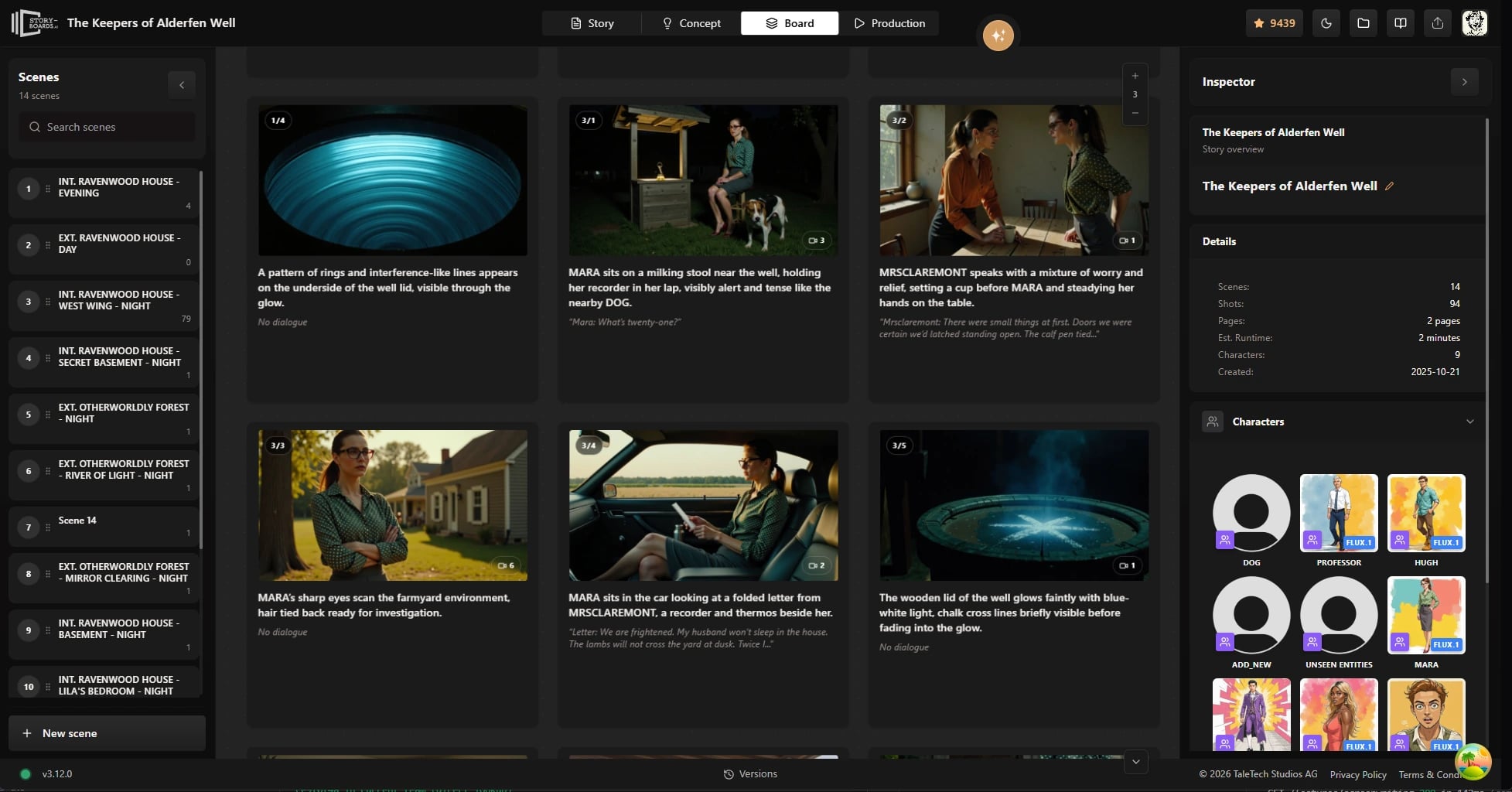
Storyboards and a layout pass set shot size, blocking, and edit rhythm before expensive motion is generated.
Characters, sets, and props are built or referenced; performances are staged; light is designed so shots cut together.
Approved motion is cut, mixed, graded, and exported as masters plus campaign versions.
Why 3D
Once a character or set exists, later shots can reuse it—critical for pilots, episodes, and product series.
Pushes, orbits, and coverage feel cinematic because the space is real, not faked shot by shot.
Products, environments, and skin read as physical—useful when the object itself is the story.
Comparison
| Need | Commissioned 3D production | In-house 3D software |
|---|---|---|
| Outcome | An approved film with sound and delivery masters | Assets and renders you still have to direct and finish |
| Continuity | Characters and spaces held across the cut | Depends entirely on your in-house pipeline |
| Review | Milestones, notes, and one delivery owner | Internal Slack threads and version chaos |
| Best fit | Launches, pilots, branded films, product heroes | R&D, stills, or a team that already owns CGI |
Use cases
Brands
Show scale, materials, and environments that a practical shoot cannot reach on the calendar.
IP owners
Prove a cast and world in space—camera coverage that stills and 2D boards cannot sell.
Agencies
One spatial language reused across cutdowns, locales, and sequels.
FAQ
Related
What you actually buy when you hire a 3D studio.
ContinueHow to choose a format for a brief and a budget.
ContinuePerformance, continuity, and why faces are hard.
ContinueTypical 2D and 3D budget bands.
ContinueShare references and runtime for a scoped 3D quote.
ContinueSend the story, the look you want, and the deadline. We will tell you whether 3D, 2D, or a hybrid is the honest production path.